
Which Accent is Better, British or American?
When starting to learn English, many students wonder which accent they should learn. After all, there is a long list of accents to chose from, each with different pronunciation features. Which accent is correct, British or American? Or is it Australian?
Here’s something to think about: does the accent you learn even matter?
Today, we’re taking a look these questions so that you can make the right choice without stress. Take a seat, sip your coffee, and relax. For the next 5 minutes, let's talk about pronunciation and accents.
Jump to:
Article Overview:
Students worry about which English accent they should learn and if sounding like a native speaker is important. However, there is no perfect accent for every situation, and it is often better to build an awareness of English accents more broadly than to master one. Accents can lead to phonetic changes such as palatalisation and affricates, and it helps to train your ears to understand these features.
See the FAQ section at the bottom of this page for a translation of difficult vocabulary.
Is American English better than British English?
The truth is that neither American English (AE) nor British English (BE) is right or wrong or better than the other. Each has been shaped by history, politics (the American Revolutionary War, for example), and a bloody great ocean 🌊
But I want to talk about one pronunciation difference between AE and BE, and how your first language (Czech, presumably) might inform your preferences.
The following might surprise you.
How a film got me thinking about pronunciation
2024 saw the release of Dune: Part Two, a science fiction adventure starring Timothée Chalamet and Zendaya.
This is a high-budget, action-packed film (or “movie”, if you prefer American English). I wasn't surprised when my students started asking me about it and wanted to know if I liked it or not.
And I think one of the small but significant reasons for Dune's success in the Czech Republic was recognition. Phonetic recognition.
What is Phonetic Recognition?
You experience phonetic recognition when you read or hear a phoneme, syllable or word that looks or sounds familiar to you.
Imagine a Czech friend who doesn’t speak any English, not a word. If I pointed at someone in the street and said, “auto mechanic”, your friend would probably think: Automechanik? Rozumím anglicky! (Auto mechanic? I understand English!).
Auto mechanic and automechanik are unmistakably similar. You would have to be deaf and blind not to see the similarity.
Here are a handful of examples from my own personal experience:
Auto
víkend
Turista
Banka
Uniform
Telefon
When first I saw/heard these Czech words, a bright light came on in my head💡
I understood, and it felt so good to finally understand something. Actually, these words almost sounded English. Understanding was effortless!
And I think the same can be said for the title of the film Dune (or “duna” in Czech) ✌️
Now, you might think I'm overstating the significance of this phonetic similarity and how it affected the film's popularity in the Czech Republic. Maybe I am. But could you at least agree that the similarity meant one less obstacle for translators and film fans?
But—surprise!—you are wrong to think “dune” and “duna” are just one vowel from being the same word.
Especially if you want to speak like the cast of Downton Abbey 🎩
The Correct Pronunciation of "Dune".
First, let’s compare the pronuncation of ‘dune” in American English and Czech, as they are the most similar.
Dune/duna:
AE pronunciation: /du:n/
Czech pronunciation: /duna/.
The above examples show there are two small differences. AE has a long /u:/ sound, while Czech has a short /u/ and an extra /a/ vowel at the end.
But the British version… adds another layer of complexity.
In a British English accent, the correct pronunciation is either /djuːn/ or /dʒuːn/. This is because of a process called palatalisation in linguistics 🤯
What is Palatalisation?
Palatalisation is a phonetic process where a phoneme (sound) is influenced by its surrounding phonemes, changing its articulation. This makes the sound more palatal. In other words, a sound is pronounced differently than expected.
Forget /dʒuːn/ for a moment. First, let me explain /djuːn/ in 3 simple steps without using too many confusing words from linguistics:
/d/ is a consonant articulated (pronounced) at the front of the mouth. /u:/ is a vowel articulated at the back of the mouth.
When /d/ is followed by /u:/, it changes the quality of /d/. The tongue moves farther back, closer to the palate (hard palate), which causes a process called palatisation.
This gives /d/ a /j/ quality on the end.
This is how /du:/ becomes /dju:/ in British English and some other accents.
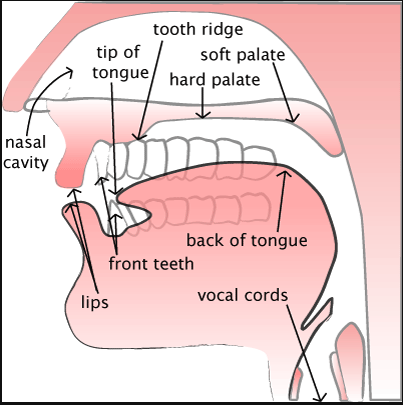
The vocal tract, showing the soft and hard palate. Sourced from https://pronuncian.com/
But I don't like palatalisation!
If you're anything like me, you're probably experiencing what I call language resistance right now 😫
You have thoughts like:
It's too complicated.
This is too much effort to learn
And I'll stick to the American pronunciation, thank you—it's much closer to Czech.
But I'm going to challenge you on that third bullet point 🤺
Either way, language resistance is something we need to overcome in language learning. It’s a distraction that stops us embracing change.
Does Palatalisation Exist in Czech Language?
Yes, palatalisation is an import feature of the Czech language, too. Look at these words:
Obědy
Koupě
Město
In all three words, ě tells us there is palatalisation between ě and the consonant before it. Think, does ě sounds different to a normal e? 🤔
Of course it does. And if you’re unsure, try saying some examples out loud.
In other cases, the Czech language puts a hook (háček) directly on the consonant to tell you it's a palatal sound. For example, ň in the word "umožňovat".
Your last shout of resistance might now be:
“But, Jamie, at least Czech uses a háček to show palatalisation!”
And well… maybe you're right—at least, I don’t know enough about Czech language to argue with you. Certainly, it’s super helpful to have these differences marked in your writing and spelling system, unlike in English where the palatalisation is invisible.
BUT, I wonder if we could find some exceptions where the palatlisation isn’t marked in Czech if we kept looking or had the help of Czech language teacher/linguist.
What's the deal with /dʒuːn/?
Here's a lightning-fast, not-so-scientific explanation of how /dju/ can become /dʒuː/ in a British English accent.
As explained above, /j/ is the sound arises because we have a transition between /d/ at the front of the mouth and /u:/ at the back. That's a long way for our tongues to move if we're talking quickly. Something might “break” if we tried that…
Try saying /dju:/ with increasing speed.
This speed should lead to another sound change in addition to the palatalisation. /dju:/ becomes /dʒuː/. Now we have created an affricate sound.

The articulation creating the /dʒ/ affricate sound, sourced from englishphonemehelp.wordpress.com.
What’s happening here to make an affricate?
Imagine you're a painter. You need the colour green, so you go to shop and buy blue and yellow. You come home and mix them together. Now you have green 😎
That's cool, but wouldn't you have saved time if you had just bought a pot of green paint from the shop in the first place? 🤷♂️
The same is happening in your mouth. In many cases, speed and efficiency encourages sound change.
/d/ and /u:/ mix together to form the affricate /dʒ/. Do you know the pronunciation of this phoneme? Think of the first sound in the English word "jam"— or in the Czech version, “džem”.
(Yes, affricates exist in the Czech language too.)
In my accent, many /du:/ sounds can become /dʒuː/.
“DU” Pronunciation Exercise:
Now you know how BE and AE produce words written with "du" differently. Look at the list of words below and predict how BE and AE speakers would say them. Sometimes they might be said the same, other times differently. And just maybe there are more varities than /du:/, /dju:/ and /dʒuː/…
What can you hear?
Word list:
Dual
Dud
Duty
Seduce
Duke
Dude
Educate
Dust
Don't forget to say them aloud in each accent! Trust me, this will really help you hear the difference—and build your pronunciation skills.
And feel free to use a dictionary to check your prediction 👂
What is the Best English Accent to Learn?
There isn’t a best accent to learn in terms of correctness. However, a particular accent of a language might be closer to your native language and pronunciation preferences. These familiarities might help your learn vocabulary quicker.
However, English is the world’s most widely spoken language. The UK alone has some 40 regional accents, and there are 160+ distinct English accents worldwide. The chances of you encountering someone or a piece of media that uses a non-standard accent is extremely high. Therefore, it’s recommended you create an awareness of accents more broadly, to be prepared for the unexpected.
Furthermore, in linguistics we try not create language hierarchies in the social sense. Linguists usually try to describe languages, dialects and accents with a neutral, more medical precision.
Below is a summary of why you might want to learn an American or British accent.
American accent benefits:
Described—anecdotally—as ‘simpler’
You prefer American media
The US is the world’s superpower
There a fewer accents in the US than in the UK
British accent benefits:
Living in the Czech Republic, you are more likely to meet British speakers
It is easier and cheaper to visit the UK from the Czech Republic
You prefer British media
The UK has a longer history than the US
English language originates in the UK—and could be viewed as the official version (not a linguistic opinion)
More accents mean more fun and a opportunity to grow better listening skills
But what about phonetic recognition? Which accent is closer to Czech and will save you time and effort?
It’s hard to say for certain, and it might depend on where you are from in the Czech Republic and the other languages you already know. However, Czech native speakers will experience phonetic recognition with both British and American accents.
Should I focus on one accent?
In the past, I advised people to focus on a particular accent. If you wanted to use British pronunciation, everything you said should have that accent and be consistent. These days, I’m more lenient. After all, mastering an accent is difficult and oftentimes impossible for adult learners.
The goal of language is to communicate, not to be perfect. While I recommend being aware of the accent and variety you’re using, feel free to have fun. Perfecting an accent is often done at the expense of learning vocabulary, grammar, hobbies and—in my personal opinion—making friends.
To learn more about why I think mastering a native accent is nonsense for most students, check out our article “I want to Sound Like A Native Speaker”.
Conclusion
Many English learners feel the need to focus on and even master a particular accent, or even to put accents into hierarchies that reflect their opinion and preferences. Linguist academics rarely look at accents in such terms, at least not without reference to the socioeconomic status of the speakers themselves. The accent itself isn’t judged.
Nevertheless, choosing an English accent to focus on can be fun and experimental. Who doesn’t want to sound like their favourite actor or singer? Phonetic recognition can also speed up your vocabulary learning process, which helps motivate you to continue learning even on bad days.
That said, there are over hundred English accents, and your chances of meeting someone or interacting with a piece of media outside your practised accent is high. Creating a broad awareness of at least the most common accents is more beneficial than mastering one—and maybe more fun, too.
FAQ
Is American English better than British English?
Neither American English nor British English can be considered better or more correct than the other. Although, many learners have their preferences. This is usually based on where they live, who their friends are, and the type of media they consume.
Is American English easier than British English?
Some people believe American English is easier, anecdotally explaining that Americans are less likely to use tenses such as the present perfect. Regardless of whether this is true or not, Czechs are more likely meet British tourists and residents in Europe. There are 1.5-2.3 billion speakers of English in the world. Less than 350 billion of them live in the United States of America.
Do you teach American or British English in your lessons?
I’m British and speak with southern standard accent, so you’ll hear mostly British English during our lessons. This will help you learn to listen to and pronounce things with a British accent.
However, I consume a lot of American media and have a degree in English Language and Linguistics. I’m used to hearing all sorts of accents, not just British, American and Czech. I firmly believe all accents are beautiful. Use the accent you’ve learned and want to learn during our lessons—and I might be able to make observations and compare the differences and similarities.
Do you use all this linguistic terminology during your English Lessons?
Usually, no. You can learn a language without linguistic and phonetic jargon. However, it can be useful, and I’m more than happy to use it, if it makes the student happy.
There are some difficult words in this article. Can you translate them for me?
Yes, here are the difficult words in this article in no particular order:
(Translated with Google, so pardon any mistakes)
Articulated - Kloubové
Hard palate - Tvrdé patro
Affricate - afrikát
Phonetic transcription - Fonetická transkripce
Phonetic recognition - Fonetické rozpoznávání
Recognition - uznání
To overstate something - něco přeceňovat
To overcome something - překonat něco
To embrace an idea - přijmout nějakou myšlenku
I’m lenient - jsem shovívavý/á
Anecdotally - anekdoticky
Jargon - žargon
To build a broad awareness of accents - budovat široké povědomí o přízvukech
Nonsense - nesmysl
furthermore - dále
